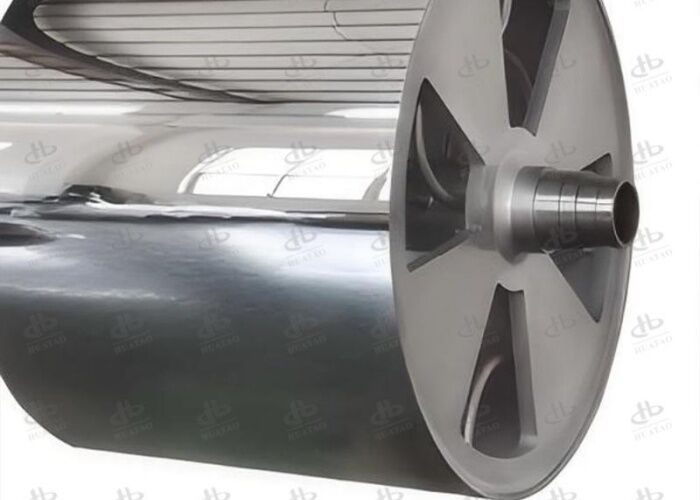
Can Industrial Rollers Be Manufactured According to Customer Drawings?
Can industrial rollers be manufactured according to customer drawings? Yes. Professional roller manufacturers build rollers exactly to customer drawings — geometry, tolerances, materials, surface treatments, internal flow channels, and dynamic balance grades — for OEM replacement and custom applications. The buyer's real task is verifying capability (equipment, in-house finishing, balancing, testing) and agreeing measurable acceptance criteria before production.
Key Takeaways
· A complete drawing is a contract: dimensions, runout, Ra, coating, and balance grade must be callouts, not assumptions.
· DFM review by the supplier adds engineering value; blind execution is a red flag.
· Acceptance = measurable reports shipped with the roller.
· No drawing? Reverse engineering from the worn roller is standard practice.
Summary Table
| Item |
Description |
| Function |
Build-to-print replacement & custom rollers for film production lines |
| Material |
Forged alloy steel, 45#/42CrMo, 304/316 stainless, aluminum |
| Application |
BOPP/BOPET/CPP casting rolls, chill rolls, MDO/TDO rolls, converting rolls |
| Service Life |
5–15+ years depending on duty, surface spec, and maintenance |
1. Knowledge Graph: Where This Topic Sits
Previous process → Current topic → Next process
· Upstream (the machine context): Resin Feeding → Extrusion → Die Head → **CASTING ROLL** / **CASTING FILM ROLLS**
· This topic: Custom / build-to-print manufacture of chill, cooling, preheating, stretching, and converting rollers for film lines — see the **FILM INDUSTRY** roll chain
· Downstream (the application): MDO Preheating (**MDO PREHEATING ROLL**) → MDO Stretching → TDO → Corona Treatment (**CORONA ROLL**) → Coating & Converting (**FILM CONVERTING ROLLS**) → Winding & Slitting
A replacement roller must re-enter this chain perfectly: same mounting interfaces, same thermal duty, same surface behavior toward the web.
2. What "Build to Print" Covers in a Film-Line Roller
A manufacturing-ready drawing specifies, and a capable manufacturer reproduces:
1. Geometry: OD, effective face length, overall length, shell wall, end caps, shafts, journals, keyways, threads, mounting details.
2. Tolerances: diameter/length tolerances; radial runout ≤0.01–0.015 mm for precision film duty; coaxiality, cylindricity, straightness for long rolls.
3. Materials & certificates: 45# steel, 42CrMo, 304/316 stainless, aluminum; UT/material certs on request.
4. Surface treatment: hard chrome (thickness + hardness), ceramic or tungsten carbide coating, rubber/PU covering with durometer, mirror polish Ra ≤ 0.01 µm for optical film, textured finishes for release control.
5. Internal structure: spiral flow channels, double-shell construction, jacket welding — executed to the drawn pattern and pressure-tested.
6. Dynamic balance: G2.5 general benchmark, G1/G0.4 for high-speed lines (ISO 1940/1).
3. The RFQ Package: What to Send for an Accurate Quote
Give every bidder the same package so you compare competence, not assumptions:
· Drawing with revision status (or the worn roller for reverse engineering + measurements)
· Material spec and certificate requirements
· Functional surfaces and critical tolerances
· Surface treatment callouts (type, thickness, hardness, final Ra)
· Operating conditions: speed, tension, temperature, nip load, substrate (BOPP/BOPET/CPP/PE), environment
· Balance grade and speed range
· Inspection/documentation requirements
· Packaging, preservation, transport constraints; delivery window
Partial data? Say so — a good manufacturer identifies what must be fixed before production and what can remain flexible. A quote that arrives instantly with zero questions is a price, not a proposal.
4. DFM Review: The Value Step
Manufacturers with engineering depth review the drawing and push back:
· Tolerance realism (is 0.002 mm runout necessary — and payable — for this application?)
· Structural improvements: journal strength, wall thickness, end-cap welding
· Flow-channel optimization: spiral pitch, annular gap, inlet/outlet routing vs your pump reality
· Sensible surface substitutions: ceramic where chrome abrades; satin where release beats gloss
· Material behavior: stress-relief sequencing to prevent distortion in long rolls
Ask every candidate: "What would you change in my drawing, and why?" Specifics = capability. Silence = machine shop.
5. Supplier Verification Checklist (B2B)
| Capability |
Evidence to Require |
Risk If Missing |
| Large machining |
CNC lathe + grinder sized to your roll |
Geometry drift on long/heavy rolls |
| Thermal internals |
Deep-hole drilling, welding, pressure test cert |
Leaks, blocked channels, capacity shortfall |
| In-house finishing |
Chrome/ceramic/rubber with hardness + thickness reports |
Broken quality chain, interface disputes |
| Balancing |
Dynamic balance reports to ISO G grade |
Vibration → MD gauge bands |
| Metrology |
Runout setup, CMM, roughness tester |
"Trust us" acceptance |
| Documentation |
Material/dimensional/balance/coating reports |
No traceability, no baseline |
One coordinated supplier across all steps reduces interface risk: unclear allowances, transport damage, and orphaned problems multiply with every handover. Review HUATAO's **ABOUT US** capability summary and **CASE STUDIES** before shortlisting.
6. Tolerances & Acceptance Criteria
· Radial runout / TIR: ≤0.01–0.015 mm on defined datums (precision film duty)
· Cylindricity/crown: governs nip pressure and cross-web gauge
· Surface roughness: Ra 0.005–0.01 µm mirror for optical BOPET; 0.05–0.3 µm for packaging grades
· Dynamic balance: per drawing grade with report
· Coating: thickness + hardness + adhesion method named
· Thermal rolls: flow + pressure-drop test, hydrostatic leak test, surface temperature uniformity map at load (±1 °C typical; ±0.5 °C optical/separator)
Agree method + reporting format before production starts.
7. Reverse Engineering When Drawings Are Lost
Measure the worn roller (geometry, crown, grooves, journals, bearing seats) → identify materials/compound → produce a new drawing → correct the original's failure causes rather than copying them. For thermal rolls, inspect internals during disassembly: scale, corrosion, and leaks usually explain the performance loss that started the project.
8. Failure Analysis
| Problem |
Possible Cause |
Recommended Solution |
| Roll doesn't fit machine |
Incomplete drawing; assumed bearing details |
Pre-production dimension confirmation; supply old roll |
| MD gauge bands at speed |
Runout/balance beyond limits |
Balance + runout reports at operating speed |
| Cooling/heating shortfall |
Channels not to drawing; fabrication debris |
Flow/ΔT test + flush certificate before shipment |
| Chrome wear/peeling |
Thickness/adhesion below spec |
Specify thickness, hardness, adhesion test |
| Leakage at joints/end caps |
Weld/seal quality; overpressure mismatch |
Hydrostatic test; joints rated for circuit pressure |
| Cost disputes at delivery |
Quote excluded reports/packaging |
Itemized quote stating included/excluded scope |
| New roll worse than old |
Legacy design flaws copied |
Demand DFM feedback; correct root causes |
9. Maintenance Guide
· Daily: visual surface check; noise/vibration awareness
· Weekly: surface temperature scan at load vs commissioning map
· Monthly: runout spot check; bearing lubrication per schedule
· Quarterly: coolant flow/ΔT/pressure vs baseline (10% drift = fouling signal)
· Annually: full dimensional + balance recheck; coating thickness on wear zones
· Keep drawing revisions with maintenance logs; stock spare rotary joints and bearing sets
10. Case Study
Customer Type: South American BOPP film producer
Film Type: BOPP packaging film, 7.4 m web
Operating Conditions: High-speed casting; cost-sensitive replacement program
Problem: OEM replacement chill rolls were slow and expensive; fixed downtime windows
Solution: HUATAO manufactured chrome-plated chill rolls to the customer's drawings with full documentation
Result: Procurement cost cut by over 60%, identical interfaces, no line modification — **CHROME-PLATED CHILL ROLLS CASE**
12. Conclusion
Build-to-print rollers are routine, engineered procurement — when the RFQ is complete, the supplier reviews the drawing with judgment, capability is verified, and acceptance is measurable. Related technical reading: **MDO PREHEATING ROLLS GUIDE** and **PRS COOLING ROLLS GUIDE**
Contact: Jenny Liu | sale05@huataogroup.com | +86 17743789775 (WhatsApp/WeChat) | **CONTACT US**
Website: https://www.huataomulti-indusrolls.com/
Hashtags: #IndustrialRoller #BuildToPrint #BOPP #BOPET #FilmExtrusion #B2BProcurement #OEMReplacement #WebHandling


 Your message must be between 20-3,000 characters!