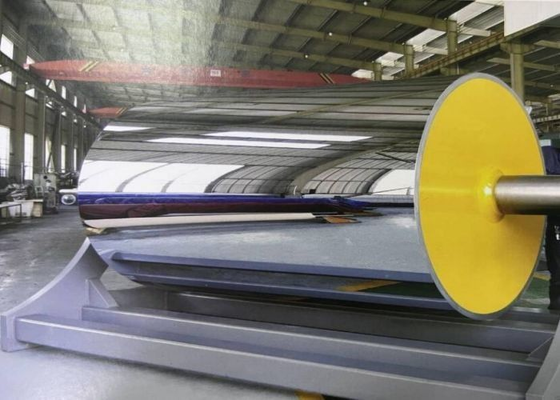
Double-Shell vs Single-Shell Chill Roll: A Complete Guide for High-Speed Film Extrusion
Quick Answer
A double-shell chill roll is a two-wall cooling roll in which a welded helical baffle turns the gap between an inner core and a thin outer shell into a continuous narrow channel. Because the core carries bending load, the working shell can be 8–15 mm instead of 25–40 mm, and because the channel is closed, coolant velocity stays at 1.5–3 m/s against the heat-transfer surface. The result is 30–50 % more effective heat-transfer coefficient and ±1 °C cross-web uniformity, or ±0.5 °C with variable pitch. That is worth paying for above roughly 250 m/min on wide webs, and usually not below 150 m/min on non-optical grades.
Key Takeaways
· Thermal performance is set by shell thickness and coolant velocity, not by diameter.
· Cross-web uniformity, not average temperature, determines haze, gauge and crystallinity.
· A double-shell circuit drops three to six times more pressure than an open cavity.
· Narrow channels foul first and cannot be brushed, so filtration is a design requirement.
· "Double-shell" describes a family; pitch profile and weld quality decide the outcome.
· Acceptance must be measured at load, with production resin and production throughput.
Summary Table
|
Item
|
Description
|
|
Function
|
Controlled heat removal from a molten or semi-molten polymer web
|
|
Construction
|
Outer working shell + inner core + welded helical baffle
|
|
Outer shell thickness
|
8–15 mm for most film duty
|
|
Inner core
|
Structural; shares bending and nip load with the shell
|
|
Channel velocity
|
1.5–3 m/s, turbulent at the wall
|
|
Surface
|
Hard chrome 80–150 µm at 800–1,000 HV
|
|
Finish
|
Ra 0.02–0.05 µm (BOPP/CPP); 0.005–0.02 µm (BOPET); ≤0.01 µm (optical)
|
|
Uniformity
|
±1 °C typical; ±0.5 °C variable pitch
|
|
Pressure drop
|
Three to six times an equivalent open cavity
|
|
Service life
|
10–15 years with treated water and descaling
|
Definition
A double-shell chill roll — also called a double-jacketed or spiral-baffle cooling roll — is a heat-transfer roll in which the coolant does not occupy a free internal volume but is constrained to a helical path between two concentric cylinders. The outer cylinder is the working surface; the inner cylinder is structural; the helical baffle is welded between them and defines both the flow path and much of the roll's stiffness.
It differs from three neighbouring designs. A single-shell or open-cavity roll has one wall and an empty interior. A peripheral-drilled roll bores holes close to the surface of a thick wall. A multi-zone roll splits the face into independently controlled circuits for profiling. Each has a place; the double-shell spiral is the mainstream choice for film casting because it balances heat transfer, uniformity and manufacturability.
Working Principle
The four resistances
Heat from the polymer must cross, in series: the contact interface between web and shell; the chrome layer; the shell wall; and the coolant boundary layer.
The contact interface is usually the largest and the most neglected. Air entrapped between a smooth roll and a fast-moving web is an excellent insulator. Air knives, vacuum boxes and electrostatic pinning exist precisely to collapse that layer, and no roll design compensates for its absence.
The chrome layer contributes little resistance at 80–150 µm but governs release, wear and, through its finish, the nucleation behaviour that shows up as haze.
The wall term is thickness divided by conductivity. It is why a 12 mm shell outperforms a 32 mm shell at identical diameter and flow, and why internal structural support is a thermal feature, not only a mechanical one.
The coolant boundary layer term is inverse to the local heat-transfer coefficient. At low velocity the film of warmed water against the wall is thick and stable; at 1.5–3 m/s in a narrow channel it is thin and continuously renewed.
What the channel does
A closed helical channel does three things an open cavity cannot. It prevents short-circuiting, because there is no low-resistance path down the centre. It maintains velocity along the whole face, so the boundary layer stays thin from one end to the other. And it allows pitch to be varied: shortening the lead progressively along the face offsets the coolant's own temperature rise, flattening the surface profile that would otherwise slope from inlet to outlet.
Sizing arithmetic
Required heat removal is mass throughput × specific heat × allowable temperature drop. For polypropylene, the latent heat of crystallisation must be added; omitting it understates duty by 15–25 % on BOPP. Contact time is wrap angle in radians × radius ÷ casting speed. Coolant flow follows from duty and allowable temperature rise, and channel velocity follows from flow and channel cross-section.
Three checks catch most sizing errors: does the calculation use the thickest sheet at maximum throughput; does it use the highest seasonal coolant temperature; and does the resulting velocity stay inside the turbulent range at that flow?
Benefits
· Higher heat flux per unit face area, supporting higher casting speed at constant quality.
· Tighter cross-web uniformity, reducing gauge variation, haze and edge trim.
· Faster response at start-up and during grade changes, because the working shell has less mass.
· Better behaviour during seasonal water-temperature excursions.
· A performance specification that can be measured and enforced, rather than a dimensional one.
Applications
Double-shell chill rolls are standard on BOPP and BOPET casting sections, CPP and cast-PE lines, optical film, lithium battery separator film, extrusion coating and lamination cooling drums, and on cast sheet where surface quality matters.
They are less compelling on narrow converting lines, on slow sheet lines with long contact dwell, and on non-optical packaging grades where ±3 °C is acceptable.
Material Comparison
|
Shell material
|
Conductivity
|
Corrosion behaviour
|
When to choose
|
|
Carbon steel
|
High
|
Needs treated water and inhibition
|
Standard film casting
|
|
Alloy steel (forged)
|
High
|
Good with treatment
|
Wide, high-load rolls
|
|
Stainless steel
|
Roughly one third lower
|
Excellent
|
Aggressive water chemistry, food contact
|
|
Chrome-plated carbon steel
|
High (thin layer)
|
Good surface protection
|
Default for film grades
|
|
Ceramic / carbide coated
|
Moderate
|
Very high
|
Abrasive or highly adhesive webs
|
Application Comparison
|
Film
|
Quench sensitivity
|
Uniformity target
|
Finish
|
Design notes
|
|
BOPP
|
Moderate
|
±1 °C
|
Ra 0.02–0.05 µm
|
Variable pitch on webs above 4 m
|
|
BOPET
|
High
|
±0.5–1 °C
|
Ra 0.005–0.02 µm
|
Quench rate fixes amorphous content
|
|
CPP
|
Moderate
|
±1–2 °C
|
Ra 0.02–0.05 µm
|
Release behaviour critical
|
|
Optical
|
Very high
|
±0.5 °C
|
Ra ≤0.01 µm
|
G1.0 balance, runout ≤0.01 mm
|
|
Separator
|
Very high
|
±0.5 °C
|
Ra ≤0.01 µm
|
Cleanliness and filtration critical
|
Industry Application Matrix
|
Stage
|
Roll
|
Double-shell benefit
|
|
Casting
|
Casting Roll and chill roll
|
Highest heat flux in the line
|
|
MD orientation
|
MDO Preheating Roll
|
Even temperature across a wide web
|
|
MD stretching
|
MDO Stretching Roll
|
Stable draw without necking
|
|
Coating / lamination
|
Film Converting Rolls
|
Fast setting before winding
|
|
Winding
|
Cooling roll ahead of winder
|
Prevents blocking and telescoping
|
Selection Guide
Answer six questions in order.
1. What is the heat load? Throughput, sheet thickness, melt temperature and required exit temperature. Add the crystallisation term for PP.
2. What is the worst case? Maximum output, thickest sheet, warmest cooling water. A roll sized at average conditions delivers average uniformity when it is pushed.
3. What uniformity does the product need? ±2 °C for general packaging, ±1 °C for standard BOPP and BOPET, ±0.5 °C for optical and separator grades.
4. Is the width large enough to justify variable pitch? Above roughly 4 m, a uniform-pitch channel will show a measurable inlet-to-outlet slope unless the pitch is compensated.
5. Can the utilities deliver? A 6–8 m roll may need 60–90 m³/h at a pressure drop three to six times that of an open cavity. Check the pump curve, not the pump label.
6. Is the water treated? If not, either budget for filtration and descaling or accept a shorter interval between services.
The BOPP Chill Roll and PRS Cooling Roll pages present both architectures against these six questions.
Procurement Guide
Include the following in the RFQ.
· Duty statement: polymer grade, throughput in kg/h, cast-sheet width and thickness, casting speed, melt and exit temperatures, coolant inlet temperature in the warmest month, and whether the section uses an air knife, vacuum box or water bath.
· Sizing calculation at the worst-case combination, with assumptions stated.
· Flow and pressure drop at that duty, so the pump and piping can be verified.
· Channel geometry: number of starts, pitch profile, channel cross-section, baffle thickness, weld preparation and penetration.
· Shell drawing: material grade and certificate, wall thickness, chrome specification and thickness range.
· Inspection reports: radial runout, cylindricity, dynamic balance grade, chrome thickness, Ra trace, and hydrostatic or helium leak test of the circuit.
· At-load acceptance protocol: thermocouple traverse or infrared scan at several cross-web positions, with production resin and throughput.
Four questions separate capable suppliers from assemblers: can they manufacture to an existing roller drawing; can they supply mill certificates for shell and baffle material; can they support OEM replacement without a drawing; and can they show comparable references at similar width and speed. A professional industrial roller manufacturer answers all four with documents rather than adjectives.
Cost and Total Cost of Ownership
A double-shell roll typically costs 1.5–2.2 times a single-shell roll of the same dimensions. The premium buys uniformity, which converts into three economic effects: reduced edge trim and gauge rejects; reduced haze-related downgrade on optical and metallisable grades; and the ability to hold line speed during warm weather instead of turning down.
Against that sit higher pump energy from pressure drop, a shorter descaling interval if water treatment is weak, and a higher repair cost if a baffle weld fails. In practice the payback on a wide BOPP or BOPET line is usually driven by yield and uptime rather than energy, and commonly lands between 12 and 24 months when a measured uniformity problem exists before the replacement.
Failure Analysis
|
Problem
|
Possible cause
|
Recommended solution
|
|
Edge-to-edge gradient under load
|
Coolant warming along the face; uniform pitch on a wide roll
|
Specify variable pitch; verify flow split between paths
|
|
Centre band running hot
|
Sediment in a low-velocity zone; flow bypassing a baffle
|
Descale; pressure-test; add 100–200 µm filtration
|
|
Sudden cold band after years of service
|
Fatigue crack in a baffle weld
|
Borescope and pressure test; repair or replace the shell
|
|
Release marks, sticking, local gloss loss
|
Contaminated or worn chrome; local hot spot from fouling
|
Clean and re-polish; measure Ra; re-scan at load
|
|
Progressive loss of cooling capacity
|
Scale or biofilm on the water side; blocked filter
|
Log flow and ΔT; descale; restore water treatment
|
|
Vibration and periodic gauge bands
|
Imbalance, bearing wear, joint runout
|
Review balance report; replace bearings; check alignment
|
|
Water-side pitting
|
Untreated water; dissimilar-metal couple at the weld
|
Chemistry control and inhibitor; consider stainless shell
|
|
High pressure drop after service
|
Crushed gasket, incorrect joint, partial blockage
|
Compare against commissioning baseline; strip and inspect
|
Maintenance Guide
Monthly: log flow, inlet temperature and inlet-to-outlet ΔT; compare with the commissioning baseline. A falling ΔT at constant flow indicates fouling before film quality changes.
Quarterly: inspect the chrome face under oblique light for marking, wear tracks and edge build-up; check filter differential pressure; verify rotary joint for leakage and vibration.
Annually: measure radial runout and vibration signature at operating speed; review bearing condition; confirm balance has not drifted after any repair.
Every two to four years: descale the circuit. The interval depends on water hardness, filtration quality and whether the loop is closed. Use a descaling method approved for the shell material and neutralise thoroughly.
On any unexplained band: pressure-test the circuit before assuming a thermal fault. A baffle weld crack mimics a fouling problem and cleaning will not fix it.
Case Study
Customer type: BOPP film producer, Southeast Asia.
Film: 12–18 µm plain and metallisable BOPP, plus a metallised grade.
Operating conditions: 6.8 m casting width, 380 m/min casting speed, 2,400 kg/h, cooling water 28–32 °C in the wet season.
Problem: The line ran a single-shell open-cavity chill roll. Inlet temperature held setpoint to within 0.3 °C, yet the face showed a 3.8 °C edge-to-centre spread at load. Film carried a recurring gauge band about 900 mm from the drive side, and metallisable grades were downgraded for haze. Lowering water temperature to 24 °C reduced the symptom slightly and increased chiller energy.
Diagnosis: Flow was 45 m³/h, which gave low velocity in the open cavity. The centre of the face showed the highest temperature, consistent with sediment in a low-velocity zone. A thermocouple traverse at five positions confirmed a centre-hot profile rather than a simple inlet-to-outlet slope.
Solution: A double-shell chill roll of identical 700 mm diameter and face length, variable-pitch spiral channel, 14 mm outer shell, G1.0 balance, Ra 0.02 µm chrome. Flow was raised to 68 m³/h to hold channel velocity, and a 150 µm filtration skid was installed upstream of the rotary joint.
Result: Spread at load fell to 0.9 °C. The gauge band disappeared from the profile scan, haze on metallisable grades improved by roughly 0.4 percentage points, and the line held 380 m/min without the previous 20 m/min turndown in hot weather. Calculated payback was 14 months on yield and energy; the first descaling was required at 26 months. Two comparable wide-web projects are documented in the Case Studies library: the Chrome-Plated Chill Rolls: South American 7.4m BOPP Case and the Corrosion-Resistant Chill Rolls: North America 8.7m BOPP Case.
FAQ
Is a double-shell chill roll always better than a single-shell roll?
No. It is better whenever heat flux and web width make uniformity the limiting factor for quality or speed. On narrow, slow, non-optical lines, a well-made single-shell roll with an internal displacer delivers acceptable uniformity at lower capital cost and with easier cleaning access.
At what line speed does double-shell construction become necessary?
No universal threshold exists. As a rule it becomes the default above roughly 250 m/min on webs wider than 3 m, or whenever ±1 °C uniformity is specified. Below about 150 m/min on non-optical grades the benefit is usually marginal.
Is "double-shell" the same as "double-jacketed" or "spiral baffle"?
They describe one family. Double-shell and double-jacketed refer to the two concentric cylinders; spiral baffle describes the element creating the channel. What separates a good roll from a poor one is pitch, channel section and weld quality.
Does a thicker shell give better cooling?
The opposite. Radial resistance is proportional to wall thickness, so a thicker wall slows heat flow and adds thermal inertia. Thickness is chosen for stiffness and pressure containment, and double-shell construction exists partly to keep it as low as possible.
What flow and pressure drop should I expect?
Flow follows duty, typically 1.5–3 m/s channel velocity, which on a 6–8 m roll means 60–90 m³/h. Pressure drop across a narrow helical circuit commonly runs three to six times that of an open cavity, so size the pump against the roll's own curve.
Can an existing single-shell roll be converted?
Practically no. Conversion needs a new shell assembly, baffle, journal and joint arrangement, plus re-balancing. A new roll almost always costs less and arrives with a warranty.
How is temperature uniformity verified before acceptance?
With an at-load test: production throughput, representative resin, and a thermocouple traverse or infrared scan at several cross-web positions. A no-load measurement proves nothing and should not be accepted as evidence.
What water treatment does the design require?
Filtered, inhibited, closed-loop water at stable temperature, with 100–200 µm filtration upstream of the rotary joint. Untreated water shortens the descaling interval, attacks baffle welds and eventually forces premature replacement.
How long will the roll last?
Ten to fifteen years with treated water, scheduled descaling and chrome maintenance. Refurbishment is usually viable at 40–60 % of new cost if the shell and baffle are sound; a cracked baffle changes that calculation.
Does the design change for BOPET compared with BOPP?
Yes. BOPET demands a finer finish and tighter uniformity because quench rate determines amorphous content, and it is more sensitive to oligomer plate-out. Start from the Casting Film Rolls range and adjust finish, pitch and filtration accordingly.
Conclusion
For high-speed, wide-web film extrusion, the double-shell chill roll is the better engineering answer, and the reason is structural as much as thermal. Internal support allows a thin working shell, which removes radial resistance; a closed helical channel maintains velocity at the wall, which removes boundary-layer resistance. Together they deliver 30–50 % more effective heat-transfer coefficient and a uniformity band that can be specified, measured and enforced.
It is not a universal upgrade. It costs 1.5–2.2 times more, drops three to six times more pressure, and punishes poor water treatment more severely than an open cavity. On narrow, slow, non-optical lines it buys margin nobody needs.
The decision belongs to a duty calculation at the worst case. The specification belongs to the purchase order: pitch profile, channel geometry, shell thickness, balance grade, chrome specification and an at-load uniformity protocol. Buyers who write those six items get the performance they paid for. For the surrounding equipment, review the Bi-Oriented Film Rolls range and the Film Industry hub, and read the PRS Cooling Rolls for BOPP, BOPET and BOPA Lines guide before writing the RFQ.
Contact
Jenny Liu
Email: sale05@huataogroup.com
Website: https://www.huataomulti-indusrolls.com/
Phone / WhatsApp: +86 177 4378 9775
Hashtags
#ChillRoll #DoubleShellRoll #FilmExtrusion #BOPP #BOPET #CastFilm #CPP #FlexiblePackaging #IndustrialRoller #HeatTransfer #RollerMaintenance #TemperatureControl #FilmProduction #Procurement #EngineeringDesign #ProcessOptimization


 Your message must be between 20-3,000 characters!